Public Health and Housing
– Maria Godoy on NPR (Nov. 2020)
“The neighborhood in which you live is one of the biggest predictors of your health… people who live in neighborhoods that were once subjected to redlining are today more likely to experience shorter life spans – sometimes, as much as 20 or 30 years shorter than other neighborhoods in the same city.”
Public Health and Housing
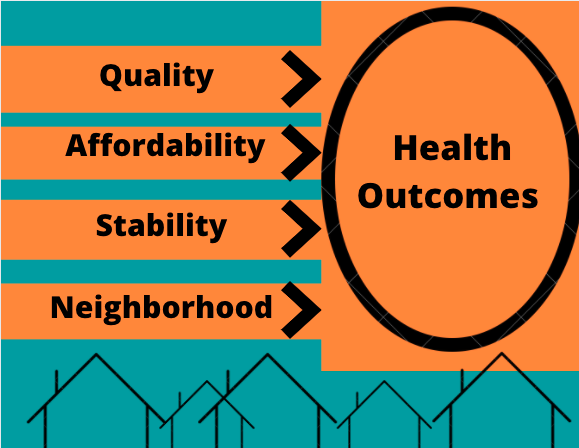
One’s health outcomes are affected by the quality, affordability, and stability of one’s housing.
Low-quality housing can also have a range of negative health outcomes. The presence of lead in a home’s paint can lead to lead poisoning while asbestos, which is found in insulation, can cause cancer. The growth of mold inside one’s home can cause a variety of health impacts, including respiratory issues and itchy eyes. Further, pest infestations can lead to the spread of disease. Low-quality housing can also provoke household injuries and mental distress.
Living in housing that is difficult for one’s family to afford can also have large health consequences. Affordable housing is a major issue in the United States: as of 2015, 38.9 million American families were “cost burdened” by their housing, meaning 30% or more of their income went to their mortgage or rent. Families that spend so much of their income on housing are less able to invest in other goods, including health insurance, medical care, and high-quality food. Further, Lauren Taylor, a PhD at NYU School of Medicine, found that homeowners who are behind in their mortgage payments are also more likely to lack a sufficient food supply and go without prescribed medications.
Housing stability is also connected to health: unstable housing can cause mental distress or result in homelessness, which is tied to lower health outcomes.
The environmental characteristics of one’s neighborhood, such as air quality and whether it has tree cover or is in an “urban desert,” also affect one’s health. Living in a neighborhood with low air quality can asthma and other respiratory issues, while living in an area with low tree cover can increase the risk of heat exhaustion. Black Americans are more likely to live in neighborhoods with low air quality and other environmentally hazardous characteristics due to historical redlining practices.
Race and Redlining
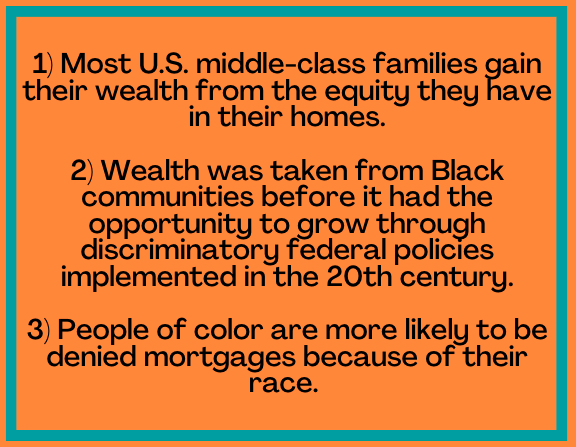
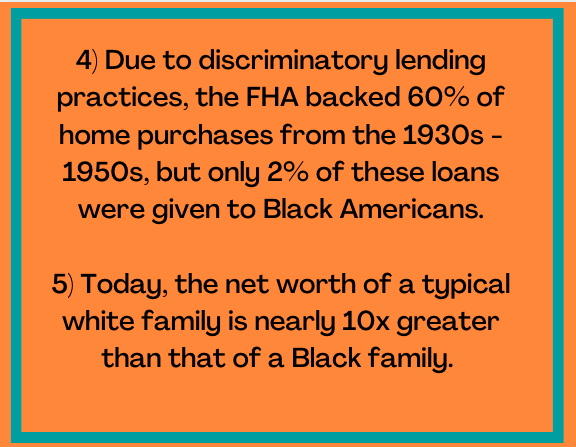
Redlining can be understood as the set of discriminatory and racist housing policies that prevented Black American families from buying homes in certain neighborhoods. Redlining policies included refusing to give mortgages or loans to creditworthy borrowers due to their race when they were interested in purchasing a home.
“Because black folks weren’t born with money and a lot of white folks weren’t born with money either, but the ones that want to make something out of themselves, them the ones that the bank turn down. They’ll give it to the Africans, they’ll give it to the Hmongs, they’ll give it to the white folk but the black man walk up in there, they’re going to judge him. His shoes better be shining, he’s got a tie on and a briefcase with just paper in it because if he don’t, they ain’t going to give him nothing. And that’s real.”
– Minneapolis Black Business Owner, 2020
Redlining has caused inequitable access to housing…
Map of Redlining Policies vs. Map of Modern Day Residential Segregation in Minneapolis
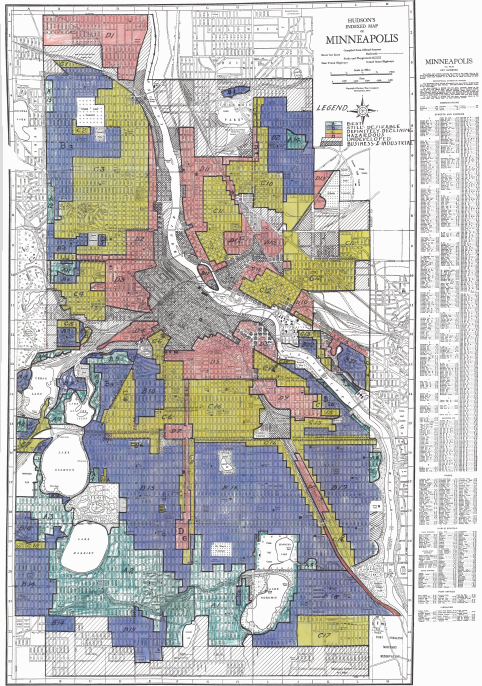
Map of redlining in Minneapolis 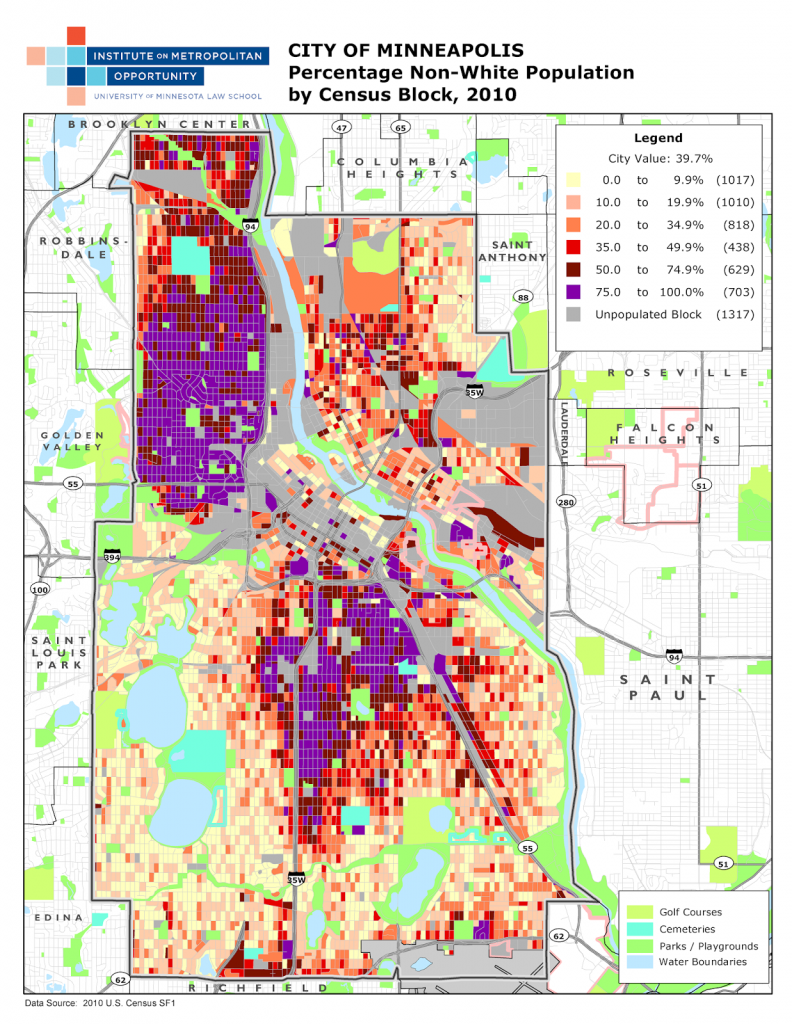
Map of percentage of non-white population by 2010 Census block
The Modern-Day Health Effects of Redlining
Racism in historic housing policies is directly related to the disparities in health between Black and White Americans. The lack of access to housing ownership has detrimentally impacted the Black American’s ability to accrue and pass down generational wealth. It also impacts the environment in which Black Americans live. Redlined neighborhoods tend to be hotter because they have fewer trees and green space in general. Additionally, redlined areas tend to have higher levels of pollution and fewer places to exercise and buy healthy food. All of these factors influence health outcomes in individuals and are mediated through the place they live and an individual’s relationship to it.
On top of that, because housing wasn’t invested in these neighborhoods, the buildings themselves became neglected. This results in a higher prevalence of mold, asbestos, lead paint, and other health hazards that can negatively affect health outcomes in a population systematically exposed to them at higher rates.
The result of this is that health outcomes are significantly worse in redlined districts than in non-redlined ones. Reports suggested that living in redlined neighborhoods is associated with higher rates of chronic diseases including asthma, diabetes, hypertension, obesity and kidney disease. Children born in these redlined districts are more likely to be born preterm, have a smaller gestational size, and have a higher rate of infant mortality.
Researched and written by Maya Donovan and Ella Stack
